

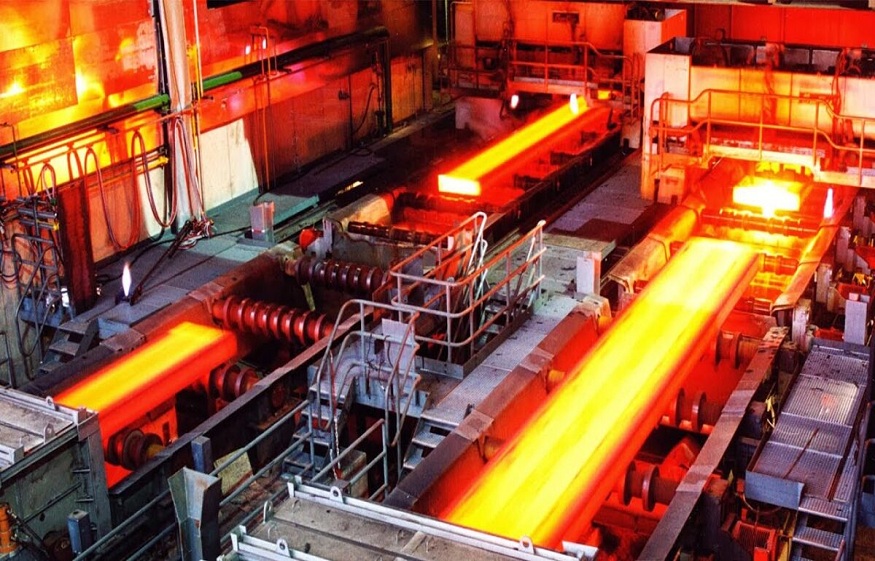
Steel strength is shaped not only by chemical composition, but also by how accurately heat and deformation are controlled on the rolling line, where tighter sensing and smarter cooling can reduce variation while supporting efficient throughput in modern mills.
This blog explains how modern hot rolling controls strength, consistency, and efficiency in daily steel production.
Controlled Rolling Makes Steel Stronger
In controlled rolling, the slab is reduced in several planned passes instead of a few heavy reductions. Each pass is done in a chosen temperature window so that grains inside the steel become finer and more uniform.
When a hot rolling mill follows these schedules, the result can be higher strength and better toughness without relying only on heavy alloy additions, which is important for long span bridges, metro systems and industrial sheds.
Thermo-Mechanical Processing Reduces Alloy Dependence
Thermo-mechanical processing links deformation and cooling in a single designed route. The rolling schedule, finishing temperature and cooling pattern are selected together so that strength develops during processing.
Read More: What First-Time Investors Should Know Before Getting Started
In a modern hot strip mill, this helps to achieve the required strength levels with optimised chemistry. It also supports stable bending, forming and welding behaviour, so fabricators can plan procedures and meet project specifications with greater confidence.
Accurate Temperature and Cooling Control Improves Consistency
Temperature is one of the most sensitive levers in hot rolling. Accurate measurement at each stand and tight control between furnace, roughing and finishing sections make steel rolls more consistent from coil to coil.
When cooling on the run-out table and coiling temperature are also controlled, the mill can supply steel with predictable strength and impact values, which supports designers who specify steel for building or infrastructure work.
Automation Improves Quality and Productivity
Automation has changed how rolling floors operate. Sensors, process models and high-speed control systems work together to keep thickness, shape and temperature within narrow bands.
Read More: The Future of Online Mutual Funds: Innovations, Trends, and Predictions
Automatic gauge control and shape control react faster than manual corrections, so oversized material is reduced. Automated inspection and data recording also help teams trace back the root cause of issues and adjust set-ups before the next rolling campaign.
Energy Efficiency as an Outcome of Controlled Hot Rolling
Energy cost is often a major focus area in rolling operations. When the process is stable and well controlled, energy use per tonne can move in a favourable direction over time. Careful design of reheating, rolling and cooling routes also supports better use of waste heat and more efficient operation of utilities.
- Reduced reheating through smoother casting and rolling coordination
- Fewer rolling passes for the same finished thickness
- Optimised combustion and furnace operation for lower specific fuel use
- Lower rejection and rework, which avoids repeating energy-intensive steps
Improved Downstream Performance
The quality built in during hot rolling shows up clearly in downstream stages. Stable and well-controlled material helps fabricators, erectors and coating shops manage their work in a smoother way. This can support tighter project schedules, fewer unplanned repairs and more predictable workforce planning at yards and sites.
- Forming and bending become more predictable, with fewer cracked or distorted parts
- Dimensional accuracy supports faster fit-up at the site and reduces cutting and grinding
- Consistent mechanical properties give welders a narrow working window for heat input
- Improved surface quality that supports coatings and corrosion protection systems
Conclusion
Modern hot rolling mill technology is generally built around control, repeatability and measurable performance. By managing deformation, temperature, cooling and automation as one system, mills are better placed to supply strong, reliable material to projects. The outcome is steel that supports safer structures, more efficient fabrication and more dependable schedules, which ultimately benefits fabricators and contractors.